AI Is Now the Ad Platform
What actually changed between 2019 and 2026 — and the five inputs the platform AI depends on.
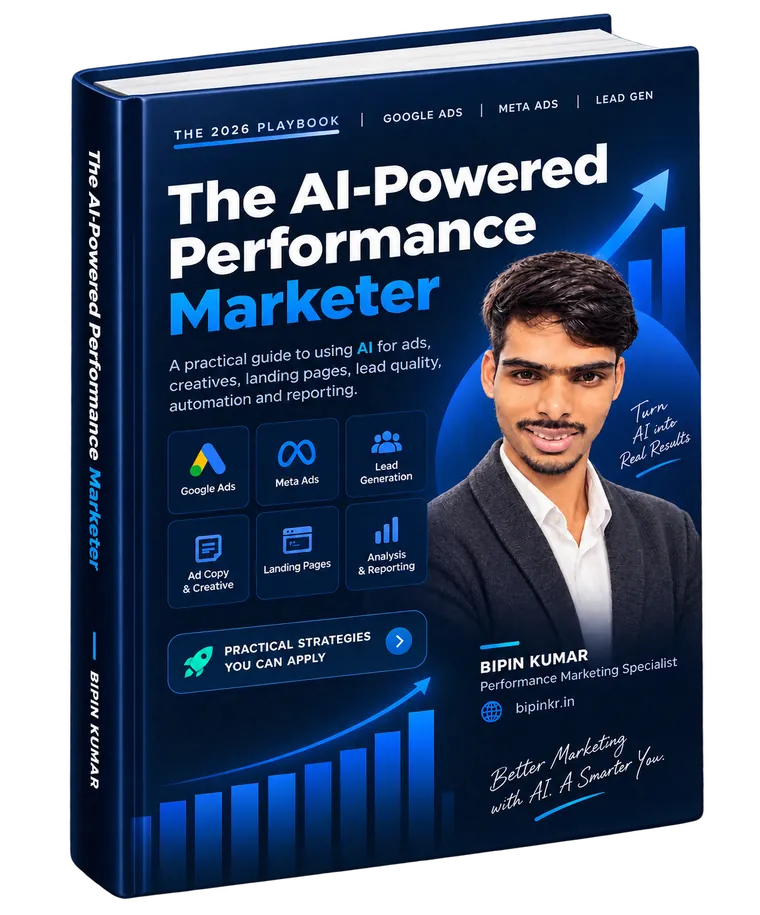
The 2026 Playbook • Google Ads • Meta Ads • Lead Gen
In 2026 the platforms' AI does the buying. Your job is to feed it better inputs and judge its outputs — this 49-page playbook shows you exactly how, across Google Ads, Meta Ads, lead quality, creative, landing pages, analysis and reporting.
Written for beginners and busy practitioners. Every chapter follows the same pattern: what changed, what it means for you, how to do it, and prompts you can copy.
Digital eBook • PDF • 49 pages
The problem
Bidding, targeting, budget distribution and creative selection are automated by default on both Google and Meta. That levels the playing field — and it exposes weak strategy faster than ever.
“Write a Facebook ad for my project” gives the model no audience, offer, proof or constraints — so it fills the gaps with the most average marketing language on the internet.
Tell the algorithm every form fill is a success and it will find you the cheapest form fills. CPL falls, close rate drops — the dashboard looks green while the business turns red.
Platform prompts push you to raise budgets and loosen matching. Some are great; some mainly increase spend. You need a question to ask before you accept one.
Most teams spend heavily on AI content generation and almost nothing on governance — the checks that catch errors, compliance problems and inflated attribution.
The core idea of the book: better inputs — clean conversion signals, a clear offer, diverse creative, relevant landing pages. Better judgement — knowing what to test, what to question, and when good-looking numbers hide bad business results.
The solution
A practical 2026 playbook that walks the whole performance marketing workflow — not AI theory. Thirteen chapters, three appendices, and a prompt for every stage where an AI assistant actually saves you time.
What you'll learn
Each chapter ends with key takeaways, and most include a copy-paste prompt you can run the same day.
What actually changed between 2019 and 2026 — and the five inputs the platform AI depends on.
A lean stack by category, the C.R.A.F.T. framework, six prompting habits and your reusable Business Brief.
AI Max for Search, the migration timeline, a safe 6-step rollout, Performance Max inputs, Ask Advisor and Asset Studio.
How Andromeda retrieval and GEM ranking work, Advantage+ defaults, and which generative enhancements to keep on.
The closed-loop system: CAPI for CRM, enhanced conversions for leads, choosing the right optimisation event.
Voice-of-customer research, six copy frameworks, the Meta copy workflow and a quality-control checklist.
The five-stage creative system, competitor teardowns, briefs and scripts, testing rhythm and fatigue signs.
Message match, speed and form friction first — then the anatomy of a lead-gen page and an AI CRO audit.
The seven-level diagnostic ladder, a 30-minute weekly routine, and budget allocation on marginal returns.
Rules, workflows and agents; what MCP connectors change; safe agent rules; the automations to build first.
The one-page report structure, the data pipeline to build once, and honest reporting rules.
Testing like a scientist, the AI output review checklist, and a 10-minute weekly governance routine.
Week-by-week actions and outputs, plus a scorecard to track CPL, CPQL, lead quality and hours saved.
What's inside
Across five parts: Foundations, The Platforms, The Funnel, Operations, Mastery.
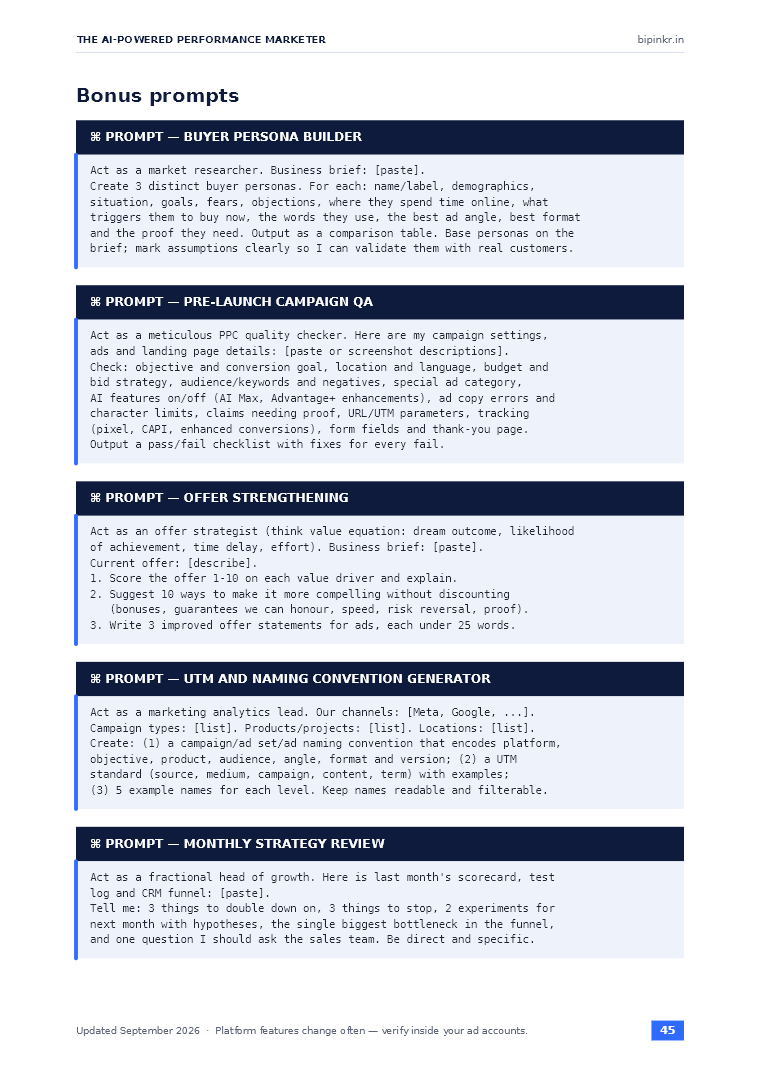
Appendix A indexes all 17 in-chapter prompts and adds 5 bonus prompts.
Safe AI Max rollout, closed-loop lead feedback, the Meta copy workflow, the creative system.
CAPI setup, ad quality control, AI output review, and the 10-minute weekly governance routine.
Real-estate creative concepts, choosing an optimisation event, message-match fixes, before/after copy.
Thirteen weeks of actions with the output each week should produce, and metrics to track.
Plain-English definitions: Andromeda, GEM, EMQ, AI Max, MCP, value-based bidding and more.
24 cited sources — platform docs, industry coverage and practitioner guides, so you can verify claims.
Everything listed above is content inside the PDF. There are no additional bonuses, courses or communities bundled with this purchase.
The prompt library
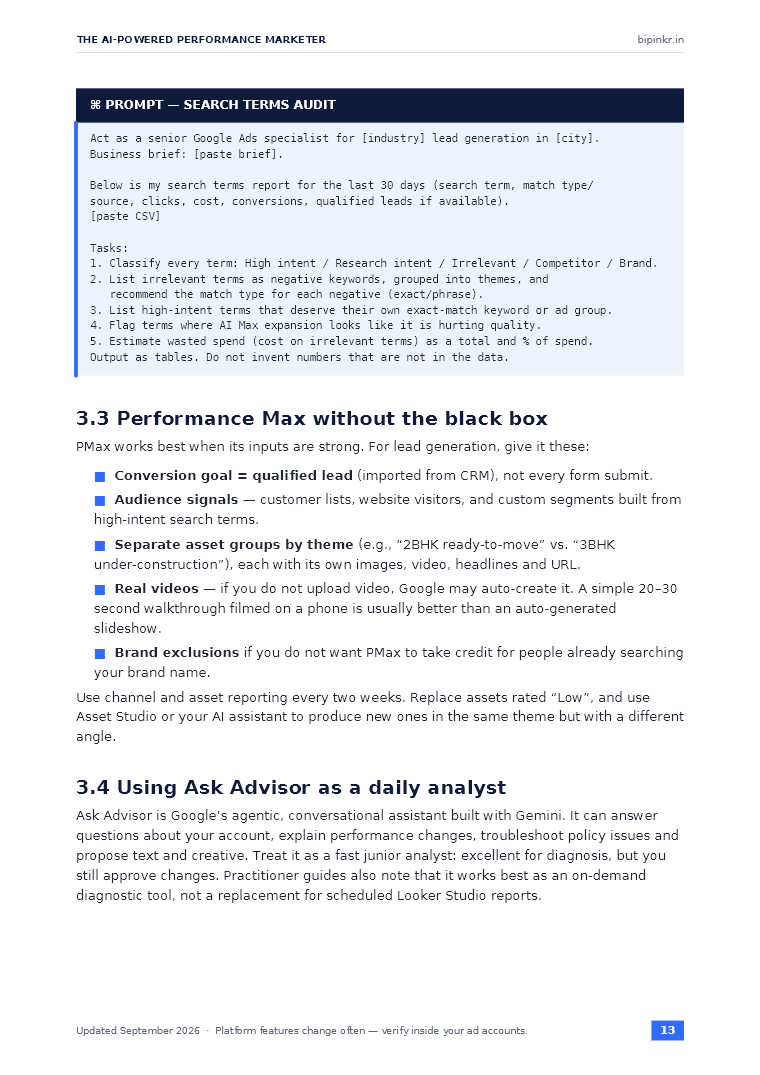
Twenty-two structured prompts written for Claude, ChatGPT, Gemini or any AI assistant. Each one asks for a specific output format and tells the model what not to invent. Two real previews from the book:
The framework
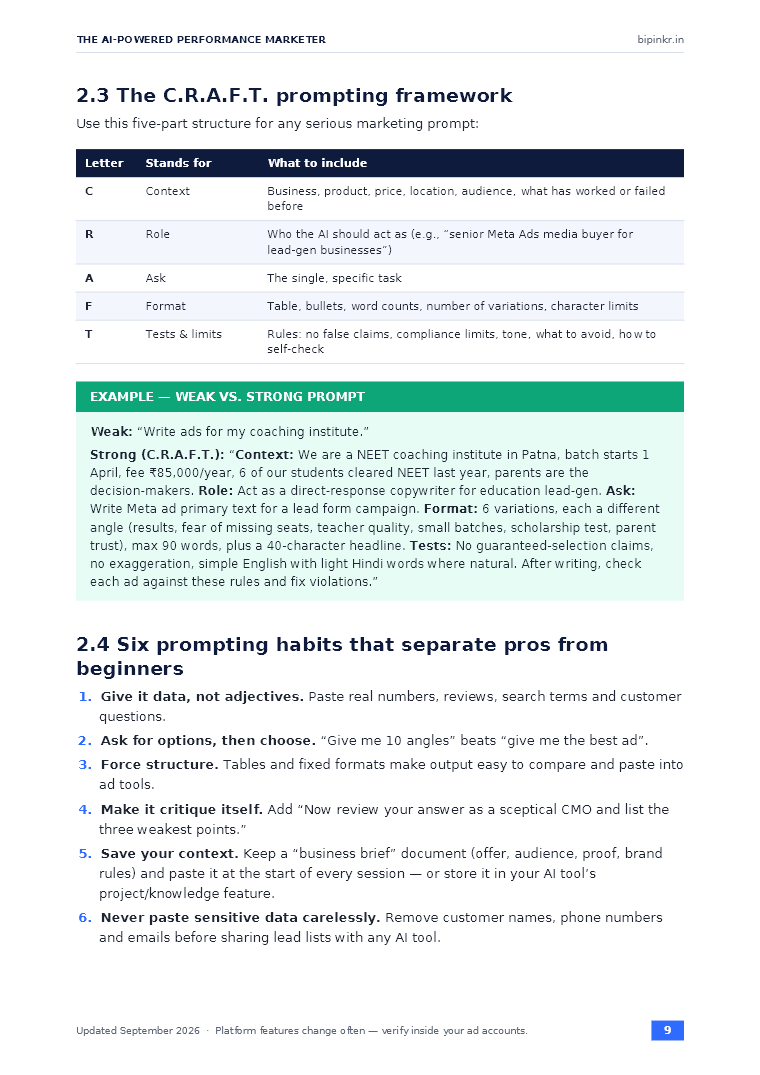
AI assistants produce generic ads because they receive generic prompts. Chapter 2 gives you a five-part structure to use on every serious marketing prompt.
Business, product, price, location, audience, what has worked or failed before.
Who the AI should act as — e.g. a senior Meta Ads media buyer for lead-gen businesses.
The single, specific task — not three tasks bundled into one request.
Table, bullets, word counts, number of variations, character limits.
Rules: no false claims, compliance limits, tone, what to avoid, how to self-check.
Weak prompt
“Write ads for my coaching institute.”
No audience, no offer, no proof, no tone, no constraints. The model fills the gaps with the most average marketing language on the internet.
Structured with C.R.A.F.T.
Context: institute, city, batch date, fee, real results, who decides. Role: direct-response copywriter for education lead-gen. Ask: Meta primary text for a lead form campaign. Format: 6 variations, one angle each, word and character limits. Tests: no guaranteed-selection claims, then self-check against the rules.
The book gives the full worked version of this prompt, plus the six prompting habits behind it.
Where you'll apply it
Every application below is covered in the book with a workflow, a checklist or a prompt.
Chapter 3
Chapters 4 & 7
Chapter 5
Chapter 8
Chapters 9–11
Chapter 13
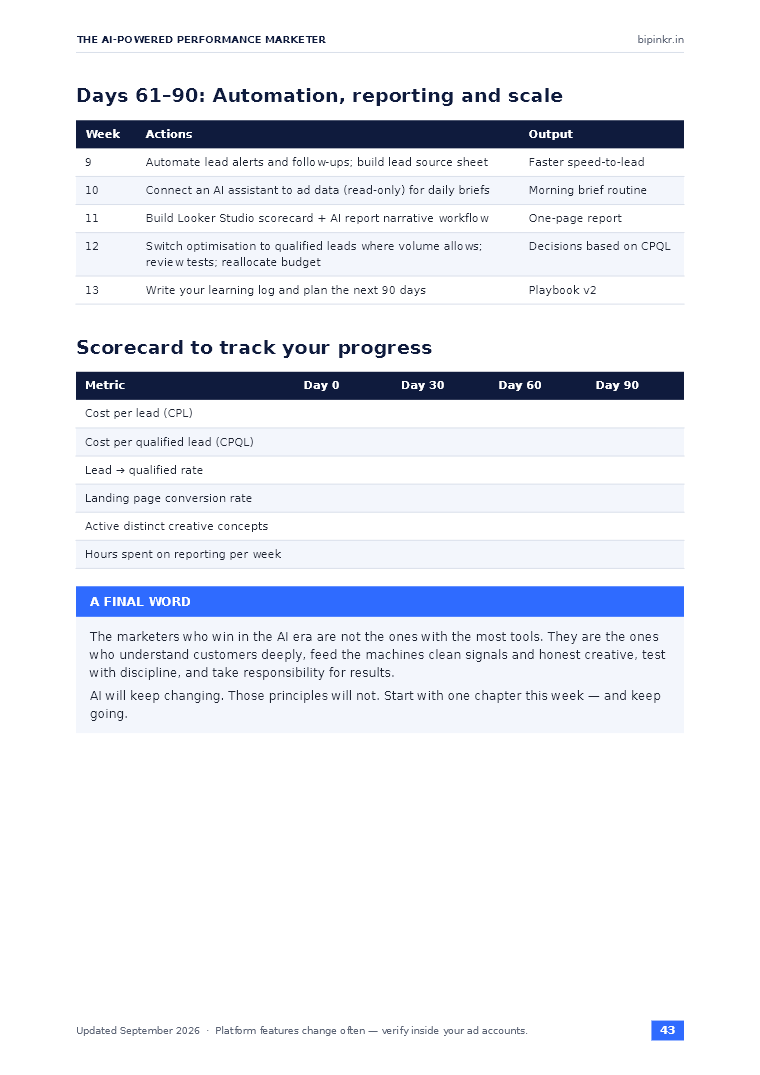
Thirteen weeks of actions, each with the output it should produce — so the book ends in a working system rather than good intentions.
DAYS 1–30
DAYS 31–60
DAYS 61–90
The chapter closes with a scorecard: CPL, cost per qualified lead, lead-to-qualified rate, landing page conversion rate, active creative concepts and hours spent reporting — measured at day 0, 30, 60 and 90.
Get This eBookAbout the author
Performance Marketing Specialist · Patna, India
Bipin works across Meta Ads, Google Ads and lead generation with a focus on real estate. He also consults on marketing strategy for education, healthcare and service businesses, and builds conversion-focused landing pages with GA4 and GTM tracking.
This first edition was researched against platform announcements, help-centre documentation and practitioner reports published up to mid-September 2026, with all 24 sources listed in Appendix C.
Inside the pages
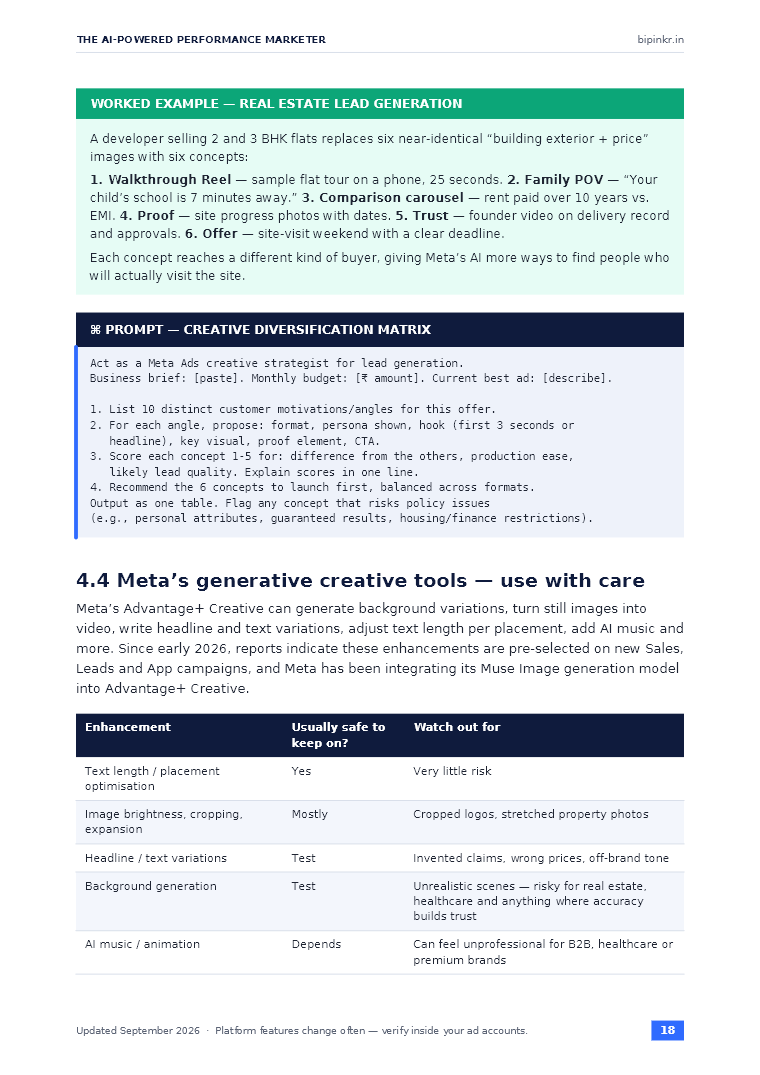
Real pages from the PDF — tables, boxed examples, warnings and prompt blocks, designed to be read on a laptop or printed.
Freelancers and junior performance marketers, business owners running their own Meta or Google ads, and agency teams that want repeatable AI workflows for audits, creative briefs and client reporting.
Yes — it is written to be beginner-friendly. Every chapter follows the same pattern: what changed, what it means for you, how to do it, and prompts you can copy. Terms like CPQL, EMQ and MCP are defined in the glossary.
Google Ads (AI Max for Search, Performance Max, Demand Gen, Ask Advisor, Asset Studio, enhanced conversions for leads) and Meta Ads (Advantage+, Andromeda and GEM, instant forms, Conversions API for CRM), plus GA4, Looker Studio and no-code automation tools.
The prompts are written for any general AI assistant — Claude, ChatGPT or Gemini. The book also covers in-platform agents such as Google's Ask Advisor and MCP connectors for working on live ad data.
No. The frameworks and prompts are industry-neutral and written for lead generation in general. Several worked examples use real estate because that is the author's focus area, and the book also speaks to education, healthcare, local services and D2C.
A 49-page PDF — 13 chapters across five parts, plus three appendices. This is the first edition, September 2026. It reads well on desktop, tablet and phone, and prints cleanly.
No, and it says so plainly. Performance numbers quoted from Google, Meta or vendors are averages reported by those companies — useful direction, not a promise. Your account can do better or worse, which is exactly why the book teaches you to test.
Ad platforms change features, names and defaults every few weeks. Everything here was researched up to mid-September 2026, and every chapter reminds you to confirm the current setting inside Google Ads or Meta Ads Manager before changing a live campaign. The frameworks outlast the feature names.
After successful payment you'll be redirected to the download/thank-you page configured by the seller, where you can download the PDF. If anything goes wrong, the support email on that page will help.
Thirteen chapters, 22 structured prompts, checklists, worked examples and a 90-day plan — so you stop improvising with AI and start running a system you can repeat, measure and defend.
Get This eBookDigital PDF • 49 pages • September 2026 edition
PDF • 49 pages